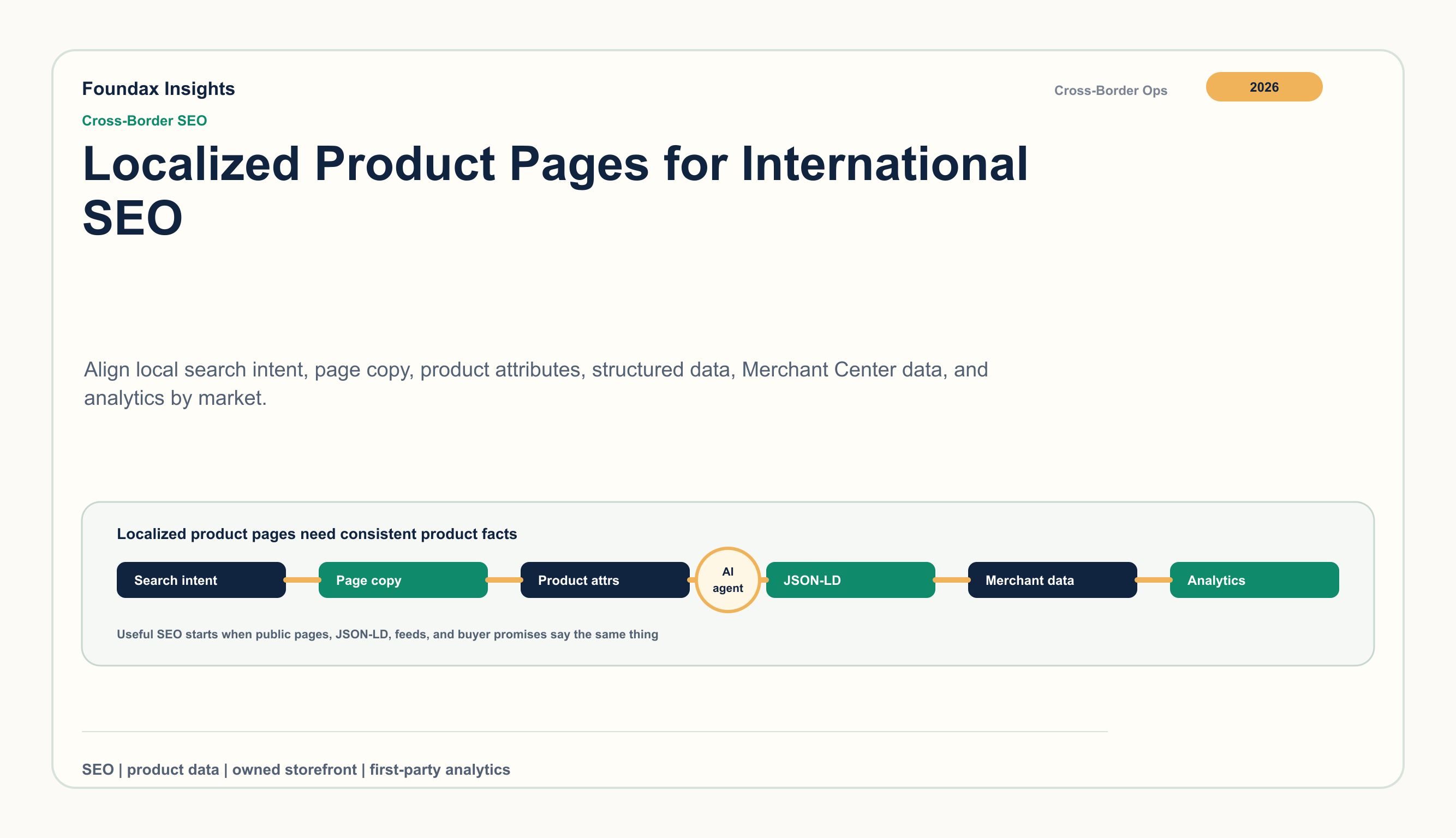
How DTC teams localize product pages for international SEO by aligning local search intent, product facts, Product JSON-LD, Merchant Center data, policies, and analytics.
A localized product page has one job: help the right buyer understand the product in the language, market context, and buying conditions they expect. Search engines and merchant systems then need to read the same product facts that the buyer sees.
Weak international SEO usually starts with a small split. The visible page says one price, Product JSON-LD carries another, Merchant Center receives an older title, and the local page links back to the wrong-language collection. The page may look localized, but the product facts are scattered.
Build Around Local Search Intent
Start with the local query, not the source-language product description. A buyer searching for running shoes, skin care, cookware, baby products, or accessories may compare different attributes by market. Material, warranty, origin, size convention, sustainability claim, compatible device, or return path may matter more than the phrases that converted in the home market.
A useful product-page brief should define:
the primary search phrase in the local language;
the comparison attributes buyers use in that market;
the objections the page must answer before checkout;
the units, sizing, imagery, and social proof that feel natural;
the internal links that keep the buyer inside the same locale.
Translation can support the work, but the page should be planned from local buying intent.
Align Visible Copy With Product Data
Google's product structured data guidance explains that product markup can help product information appear in richer Search experiences, including price, availability, ratings, shipping, and returns where eligible. Merchant listing structured data extends that machine-readable layer for shopping-oriented surfaces.
For localized PDPs, the visible page and the machine-readable data should agree on:
Product fact
Visible page
Structured data and merchant data
Title
local buyer language
same product identity, no stale source-language title
Description
local benefits and objections
same core product facts, not a separate marketing claim
Price
local currency and sale logic
matching price, currency, sale price, and availability
Variants
local size/color/material terms
mapped attributes and variant identifiers
Policy
delivery, returns, duty context
shipping and return context where supported
International SEO becomes fragile when product facts drift between these layers.
Keep Landing Page And Merchant Data Consistent
Google Merchant Center landing page requirements emphasize that the landing page should show accurate product information and include price and availability in the HTTP response whenever possible. Product data specification rules also make feed accuracy central to merchant eligibility and review.
Before publishing a localized product page, compare the page with the merchant data workflow:
title and product type;
price, currency, sale price, and availability;
image URL and image quality;
variant attributes;
identifiers, brand, and condition;
shipping, return, and policy context;
final URL and locale URL.
The buyer, crawler, and merchant feed should encounter the same product.
Use Hreflang With Real Page Differences
Google's localized-page guidance recommends hreflang to help Google understand alternate localized versions. Hreflang is a relationship signal. It works best when each URL has a clear language or regional purpose.
Check four things for each localized PDP:
The page is indexable when the market version should be public.
The canonical URL points to the localized page itself, not a different language version.
Alternate URLs exist only for real pages with meaningful localized content.
Internal links keep shoppers in the same locale unless there is a deliberate fallback.
A thin alternate page gives search systems little reason to prefer it for local queries.
Localize Proof, Policies, And Media
Product pages convert when buyers trust the details around the product. Localized SEO therefore includes more than title and description. It includes proof and operating context:
reviews or testimonials that match the target language where available;
size charts, units, and measurement examples;
delivery window, duties, returns, and warranty language;
local payment and currency expectations;
images that show relevant use cases, packaging, scale, or compliance labels.
The most useful localized product page answers the questions a local buyer would ask before contacting support.
Measure By Market, Not Only By Language
Google Merchant Center's AI-powered shopping insights announcement points toward reports such as AI shopping share of voice, product term insights, and attribute gap detection. Even outside AI shopping reports, the operational lesson is clear: localized product pages need market-level feedback loops.
Track these signals by market:
product impressions and clicks;
add-to-cart and checkout start rate;
checkout errors and payment failures;
returns and support themes;
Search Console queries by locale URL;
Merchant Center item warnings and attribute gaps.
A localized PDP should improve over time as teams learn which attributes, objections, and policy details matter in each market.
Where Foundax Fits
Foundax helps teams keep localized product-page SEO connected to the operating system behind the page. Product records, localized PDP copy, SEO metadata, Product JSON-LD, sitemap and robots behavior, Google Merchant Center preflight and sync, Search Console workflows, Content Studio, and first-party analytics can be reviewed in one workflow.
That matters because international SEO issues often come from synchronization gaps. Foundax gives operators a place to compare public copy, structured product facts, merchant feed checks, content, and measurement before and after publication.
Localized Product Page Checklist
Run these checks before publishing a market version:
Local query intent is known and reflected in the H1, title, summary, and FAQ.
Price, currency, availability, and sale logic match across PDP, cart, JSON-LD, and merchant data.
Product attributes use local terminology and complete variant mapping.
Images support local buying decisions.
Shipping, duties, returns, warranty, and support details are visible before checkout.
Hreflang, canonical, sitemap, and internal links point to the correct locale URLs.
Analytics can separate market-specific discovery, conversion, return, and support signals.
FAQ
Are translated product descriptions enough for international SEO?
Translated descriptions are only one layer. Localized product pages also need local search intent, market-specific product attributes, price and policy clarity, Product JSON-LD, merchant data consistency, hreflang, and measurement.
Should localized product pages use self-canonical URLs?
For public market versions that should be indexed, each localized product page should normally have a canonical URL pointing to itself while hreflang connects it with alternates.
Which product attributes matter most for localized SEO?
The most important attributes depend on the product category and market. Common checks include size, color, material, compatibility, pack size, origin, warranty, price, availability, shipping, and return context.
How should teams prioritize localization work across many SKUs?
Start with the SKUs that already receive international traffic, have high margin, trigger support questions, or appear in merchant-center warnings. Build a repeatable template before scaling to the long tail.
How does Foundax support localized product-page SEO?
Foundax connects product records, localized content, SEO metadata, Product JSON-LD, Google Merchant Center checks, Search Console workflows, sitemap behavior, and first-party analytics so teams can find product-page inconsistencies before they become public-market friction.