Cross-Border Ecommerce#Online Course vs Membership#Service vs Digital Product#Course vs Consulting#Digital Business Models
Online Course vs Membership Site: Finding the Right Digital Model
Compare the support burden, pricing, and required audience size for online courses, memberships, and consulting to choose the digital product model that fits your workflow.
Packaging your expertise into a digital business requires more than just deciding what you want to teach or build. The fundamental challenge is choosing a delivery model that aligns with how your customers learn, how often the information changes, and how you prefer to work. Creators and experts often gravitate toward the models with the most appealing scalability stories—like recurring revenue memberships or software—but the lowest-complexity model that reliably produces the promised customer result is usually a better starting point.
If your customer needs a quick, specific fix, placing that solution behind an ongoing membership paywall creates friction. Conversely, if your customer needs ongoing accountability and access to rapidly changing information, a static digital download will leave them unsupported. Choosing between a hands-on service, a course, a membership, or a subscription means auditing your audience's trust level, your capacity for support, and the nature of the problem you solve.
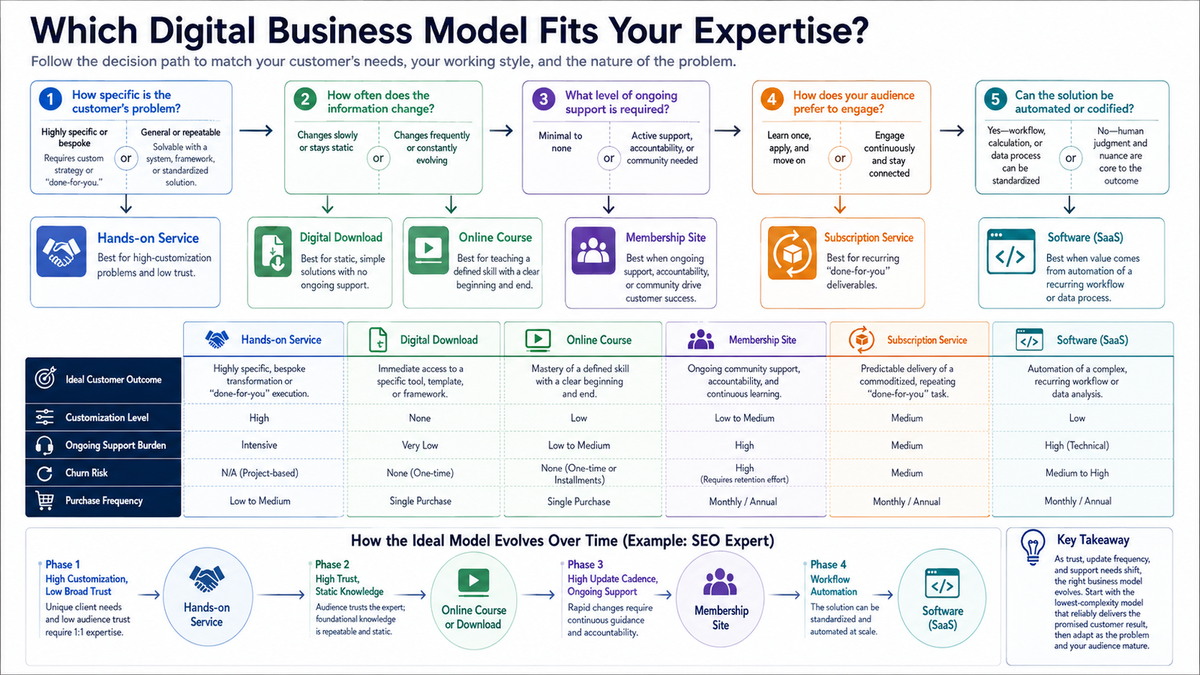
The Digital Business Model Matrix
To determine the right container for your expertise, evaluate how each model handles the key operational variables of an expert business.
Delivery Model
Ideal Customer Outcome
Customization Level
Ongoing Support Burden
Churn Risk
Purchase Frequency
Hands-on Service
Highly specific, bespoke transformation or "done-for-you" execution.
High
Intensive
N/A (Project-based)
Low to Medium
Digital Download
Immediate access to a specific tool, template, or framework.
None
Very Low
None (One-time)
Single Purchase
Online Course
Mastery of a defined skill with a clear beginning and end.
Low
Low to Medium
None (One-time or Installments)
Single Purchase
Membership Site
Ongoing community support, accountability, and continuous learning.
Low to Medium
High
High (Requires retention effort)
Monthly/Annual
Subscription Service
Predictable delivery of a commoditized, repeating "done-for-you" task.
Medium
Medium
Medium
Monthly/Annual
Software (SaaS)
Automation of a complex, recurring workflow or data analysis.
Low
High (Technical)
Medium to High
Monthly/Annual
Aligning the Model to the Problem
Your preferred way of working matters. If you dislike community management, launching a membership site will quickly lead to burnout, regardless of the recurring revenue appeal. However, the decision should ultimately trace back to what the customer needs to succeed.
When to Choose Services or Consulting
Start here if your audience's trust is low or the problem requires high customization. Services allow you to intimately understand the friction points in your methodology before you attempt to scale it. You get paid to refine your intellectual property.
When to Choose Digital Downloads or Courses
Choose a one-time purchase model when you are teaching a static skill. If you are teaching someone how to set up a home recording studio, the core principles of acoustics and microphone placement do not change weekly. An online course or a detailed digital guide delivers the specific roadmap without forcing the buyer into an unwanted ongoing commitment.
When to Choose a Membership or Subscription
Memberships excel when the customer outcome relies on ongoing accountability, networking, or adapting to a constantly shifting landscape. The tradeoff for recurring revenue is a recurring support burden. You must continuously justify the monthly fee, which introduces churn risk. Subscriptions (like productized design or copywriting services) work similarly but focus on recurring deliverables rather than community access.
When to Choose Software
If the core value of your expertise is a standardized workflow, calculation, or data process that can be coded, software scales beautifully. However, it requires the highest upfront investment and introduces complex technical support burdens that differ entirely from teaching or consulting.
Case Study: How Shifting Variables Change the Ideal Model
To see how these variables interact, consider a hypothetical expert—a consultant who specializes in search engine optimization (SEO) for e-commerce brands. As the variables of trust, support burden, and update cadence shift, the ideal business model changes.
Phase 1: High Customization, Low Broad Trust
Scenario: The expert is known locally but lacks a massive online audience. E-commerce platforms have unique, messy codebases that require bespoke technical audits.
Ideal Model: Hands-on Service. The expert charges a premium for 1:1 consulting. The high customization required makes this impossible to neatly package into a generalized $99 course right away.
Phase 2: High Trust, Static Foundational Knowledge
Scenario: After years of consulting, the expert builds a large audience. They realize 80% of their clients make the exact same foundational mistakes regarding product page titles and image optimization.
Ideal Model: Online Course or Download. The expert packages this static, foundational knowledge into a "Technical SEO Bootcamp" course. It requires a one-time purchase, carries a low ongoing support burden, and solves a definitive problem.
Phase 3: High Update Cadence, Demand for Ongoing Support
Scenario: Search engines roll out massive, continuous algorithm updates. The foundational course is no longer enough; former students constantly email asking how the new updates impact their specific stores.
Ideal Model: Membership Site. The expert pivots. The core problem now requires navigating continuous change. They launch a membership offering a monthly "algorithm breakdown" video, ongoing Q&A office hours, and a community forum. The recurring support burden is high, but the recurring revenue matches the ongoing nature of the problem.
Phase 4: Workflow Automation
Scenario: The expert realizes members spend hours manually checking their product pages for broken links and missing meta descriptions based on the membership's teachings.
Ideal Model: Software (SaaS). The expert develops a lightweight scanning tool that automates the audit process. The model shifts from community support to technical product support, changing the operational reality of the business entirely.
Evaluating your own expertise through this lens prevents you from building a high-maintenance membership community when your customers really just wanted a straightforward, one-time instructional guide.
Frequently Asked Questions
Can I bundle an online course with a membership site?
Yes, this is a common hybrid model. Creators often sell a flagship online course as a one-time purchase to teach a foundational skill, and then offer an optional, ongoing membership for alumni who want continued access to community forums, live Q&A sessions, and accountability.
Is a membership site automatically more profitable than an online course?
Not necessarily. While memberships offer recurring revenue, they also suffer from churn (subscribers canceling). An online course with a high initial price point and a low ongoing operational cost can often yield higher net profit margins than a low-ticket membership that requires constant content creation and community management to retain users.
How do I transition from 1:1 services to a digital product?
The most effective transition is to identify the repeatable steps, frameworks, or templates you use in your 1:1 client work. Package the most requested, least customized portion of your service into a digital download or short course. This allows you to test market demand and validate your curriculum before scaling back your hands-on service hours.