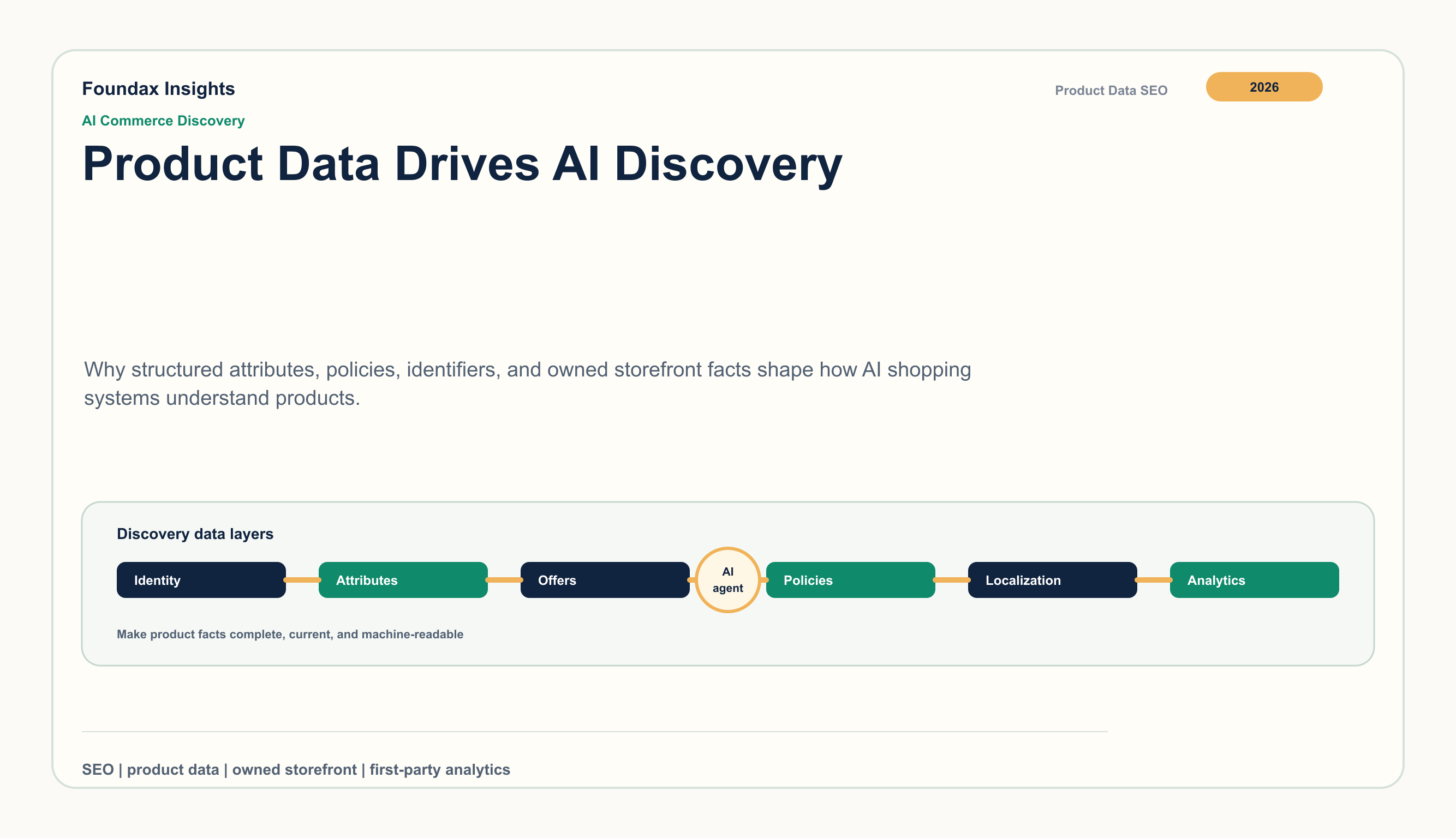
Data produk menjadi lapisan SEO untuk penemuan commerce dengan AI
Selama bertahun-tahun, SEO ecommerce dimulai dari halaman: title tag, deskripsi, backlink, internal link, dan kedalaman konten. Dasar itu tetap penting. Namun AI shopping menambahkan lapisan operasional baru: fakta produk harus cukup terstruktur agar bisa dibaca, dibandingkan, dan diverifikasi oleh sistem.
Perubahan ini terlihat dari beberapa pembaruan platform resmi. Google Merchant Center memperkenalkan AI-powered shopping insights untuk share of voice, performa shopping funnel, istilah produk, dan atribut produk. Shopify Spring '26 menempatkan Catalog sebagai infrastruktur data produk yang terstruktur dan dapat ditanyakan untuk kanal AI. Shopify Engineering menjelaskan masalah teknis di baliknya: identitas produk, skema merchant yang tidak konsisten, clustering, dan output ketat yang menjaga product ID. AWS juga memperkenalkan agentic shopping assistant yang dapat dipadukan retailer dengan katalog, konteks pelanggan, aturan bisnis, dan suara brand.
Bagi tim DTC, kesimpulannya praktis: data produk sedang menjadi lapisan machine-readable di bawah ecommerce discovery. Situs DTC, feed, halaman kebijakan, konten lokal, structured data, dan pengukuran harus menjelaskan penawaran yang sama.
Apa yang berubah pada 2026
AI insights di Merchant Center membawa kualitas data produk lebih dekat ke pelaporan permukaan berbasis AI. Dokumentasinya menyebut product term insights, product attribute insights, dan attribute completeness score untuk produk yang kekurangan atribut terstruktur seperti warna, gaya, dan material. Ini bukan sekadar kebersihan feed. Ini menunjukkan bahwa pengalaman AI shopping membutuhkan atribut yang bisa dibandingkan.
Shopify bergerak ke arah yang sama dari sisi platform. Catalog menyusun data produk dan mendistribusikannya ke kanal AI agar agent bisa menemukan, memahami, dan merekomendasikan produk. Dokumentasi agentic storefronts juga menjelaskan bahwa produk yang disindikasikan melalui Shopify Catalog dicantumkan dengan judul, deskripsi, opsi, gambar, harga, ketersediaan, dan atribut penting lain dalam bentuk yang bisa dipahami agent.
Tulisan Shopify Engineering tentang Catalog clustering memperlihatkan masalah dasarnya. Merchant yang berbeda sering mendeskripsikan produk serupa dengan cara berbeda. Identitas produk bisa terpecah. Agentic commerce membutuhkan output terstruktur yang tidak memisahkan rekomendasi dari product ID yang benar.
AWS menambahkan sisi retail. Agentic shopping assistant menggabungkan katalog, konteks pelanggan, aturan bisnis, dan brand voice. Pengalaman seperti ini hanya bekerja baik bila data dan aturan yang menjadi dasarnya konsisten.
Mengapa keyword saja tidak cukup
Riset keyword memberi tahu kata apa yang dicari orang. Commerce dengan AI juga harus memahami produk mana yang paling cocok untuk niat beli tertentu. Kueri seperti “sneaker hitam tahan air untuk komuter di bawah 120 euro” memuat kategori, warna, performa material, konteks penggunaan, dan anggaran. PDP dengan judul umum dan dua kalimat promosi tidak memberi konteks yang cukup.
Karena itu atribut produk menjadi strategis. Ukuran, material, warna, kompatibilitas, perawatan, sertifikasi, pengiriman, retur, garansi, dan logika varian bukan sekadar field backend. Itulah blok yang dipakai mesin pencari, feed, dan sistem AI shopping untuk memahami penawaran.
Konten juga berubah peran. Panduan atau FAQ tidak seharusnya berdiri terpisah dari record produk. Konten harus melengkapi konteks pembelian: siapa yang cocok memakai produk ini, batasannya apa, bagaimana varian dibedakan, perawatan apa yang penting, dan kebijakan apa yang berlaku di pasar lokal.
Enam lapisan data produk yang perlu machine-readable
Lapisan pertama adalah identitas produk: canonical URL, nama produk, brand, SKU, varian, gambar, harga, ketersediaan, dan kategori. Data ini harus konsisten antara PDP, feed, dan structured data.
Lapisan kedua adalah atribut. Untuk apparel, material, ukuran, fit, warna, perawatan, dan musim sangat penting. Untuk beauty, bahan, cara pakai, jenis kulit, sertifikasi, dan peringatan lebih menentukan. Untuk electronics, kompatibilitas, dimensi, daya, konektor, dan garansi menjadi sinyal utama.
Lapisan ketiga adalah fakta penawaran dan kebijakan: pengiriman, retur, pajak, ketersediaan, wilayah pengiriman, dan garansi. Jika halaman, feed, dan policy mengatakan hal yang berbeda, sinyal menjadi kabur.
Lapisan keempat adalah output terstruktur halaman: Product JSON-LD, metadata yang jelas, internal link, breadcrumb, indexability, dan sitemap terbaru. Elemen ini membantu sistem membaca konteks publik produk.
Lapisan kelima adalah lokalisasi. Lokalisasi bukan hanya menerjemahkan paragraf. Mata uang, satuan ukuran, ukuran pakaian, bahasa material, niat pencarian, janji pengiriman, dan FAQ harus sesuai pasar.
Lapisan keenam adalah pengukuran. Search Console, Merchant Center, first-party analytics, dan data kampanye perlu menunjukkan produk mana yang muncul, kueri mana yang relevan, dan di mana klik atau konversi terputus.
Di mana Foundax berperan
Foundax tidak perlu diposisikan sebagai pengganti Shopify Catalog, Merchant Center, atau dashboard AI shopping generik. Peran yang lebih tepat adalah lapisan operasi untuk tim DTC: data produk, halaman, konten, SEO, lokalisasi, pekerjaan Merchant Center, dan pengukuran first-party berada dalam satu workflow.
Secara praktis, Foundax membantu tim mengelola record produk, struktur SKU dan varian, metadata SEO, halaman multibahasa, sitemap, hreflang, Product JSON-LD yang dirender server, langkah Search Console, serta preflight/sync Merchant Center. GA4 dapat menjadi pelengkap diagnosis, tetapi fondasi operasional sebaiknya tidak tersebar di spreadsheet dan alat yang terputus.
Nilainya ada pada pengurangan drift. Ketika data produk berubah, PDP, structured data, feed, konten lokal, dan pengukuran tidak boleh saling menjauh. Konsistensi itulah yang membuat sinyal untuk search dan commerce discovery lebih jelas.
Rencana operasional 30 hari
Minggu 1: pilih produk dengan kontribusi revenue, margin, atau nilai strategis. Periksa judul, brand, URL, gambar, harga, ketersediaan, varian, dan atribut utama. Catat kekurangan per SKU, bukan hanya per halaman.
Minggu 2: selaraskan PDP, feed Merchant Center, dan Product JSON-LD. Perbaiki harga yang bertentangan, status stok lama, varian yang belum lengkap, dan deskripsi yang terlalu umum.
Minggu 3: tambahkan argumen pembelian dan FAQ lokal. Jawab pertanyaan nyata tentang ukuran, material, penggunaan, pengiriman, retur, kompatibilitas, dan perawatan. Tulis untuk keputusan pembelian yang bisa dikenali sistem.
Minggu 4: ukur perubahan. Periksa indexation, kueri Search Console, peringatan Merchant Center, keterlihatan produk prioritas, dan kualitas klik. Simpan catatan tentang atribut dan konten mana yang memberi sinyal paling bersih.
FAQ
Apakah data produk menggantikan SEO?
Data produk tidak menggantikan SEO; ia menambahkan lapisan machine-readable. Kualitas halaman, crawlability, internal link, relevansi konten, dan performa tetap penting. Commerce discovery dengan AI juga membutuhkan fakta produk yang bisa dibandingkan dan diverifikasi.
Field produk apa yang paling penting?
Mulai dari canonical URL, nama produk, brand, identifier, harga, ketersediaan, gambar, kategori, atribut inti, pengiriman, retur, garansi, deskripsi lokal, dan jawaban FAQ pembeli. Spesifikasi per kategori penting karena kueri natural language sering memuat detail tersebut.
Apa arti Shopify Catalog bagi brand di luar Shopify?
Shopify Catalog menunjukkan arah yang lebih luas: data produk yang terstruktur dan dapat ditanyakan sedang menjadi infrastruktur untuk kanal AI. Brand di luar Shopify tetap diuntungkan oleh PDP yang lengkap, structured data, feed, policy, dan pengukuran yang konsisten.
Bagaimana Foundax membantu workflow ini?
Foundax membantu merchant menjaga record produk, halaman multibahasa, Product JSON-LD, workflow sitemap, Search Console, preflight/sync Merchant Center, dan pengukuran first-party dalam satu lapisan operasi.
Dari mana brand kecil sebaiknya mulai?
Mulai dari produk yang sudah menghasilkan revenue. Lengkapi atribut yang hilang, selaraskan PDP dan feed, tambahkan FAQ praktis, validasi structured data, lalu amati keterlihatan dan kualitas klik selama beberapa minggu.
Bacaan terkait
Referensi