Cross-Border Ecommerce#multi-market storefront localization#international ecommerce store setup#DTC localization checklist#localized ecommerce SEO#hreflang ecommerce#Google Merchant Center preflight#cross-border operations
Checklist Lokalisasi Storefront Multi-Pasar
Checklist operasional untuk menyelaraskan halaman lokal, harga, data produk, kebijakan, hreflang, kesiapan Google, konten, dukungan, dan analytics per pasar.
Diterbitkan 30 Jun 2026Reading time: 3 menitFoundax
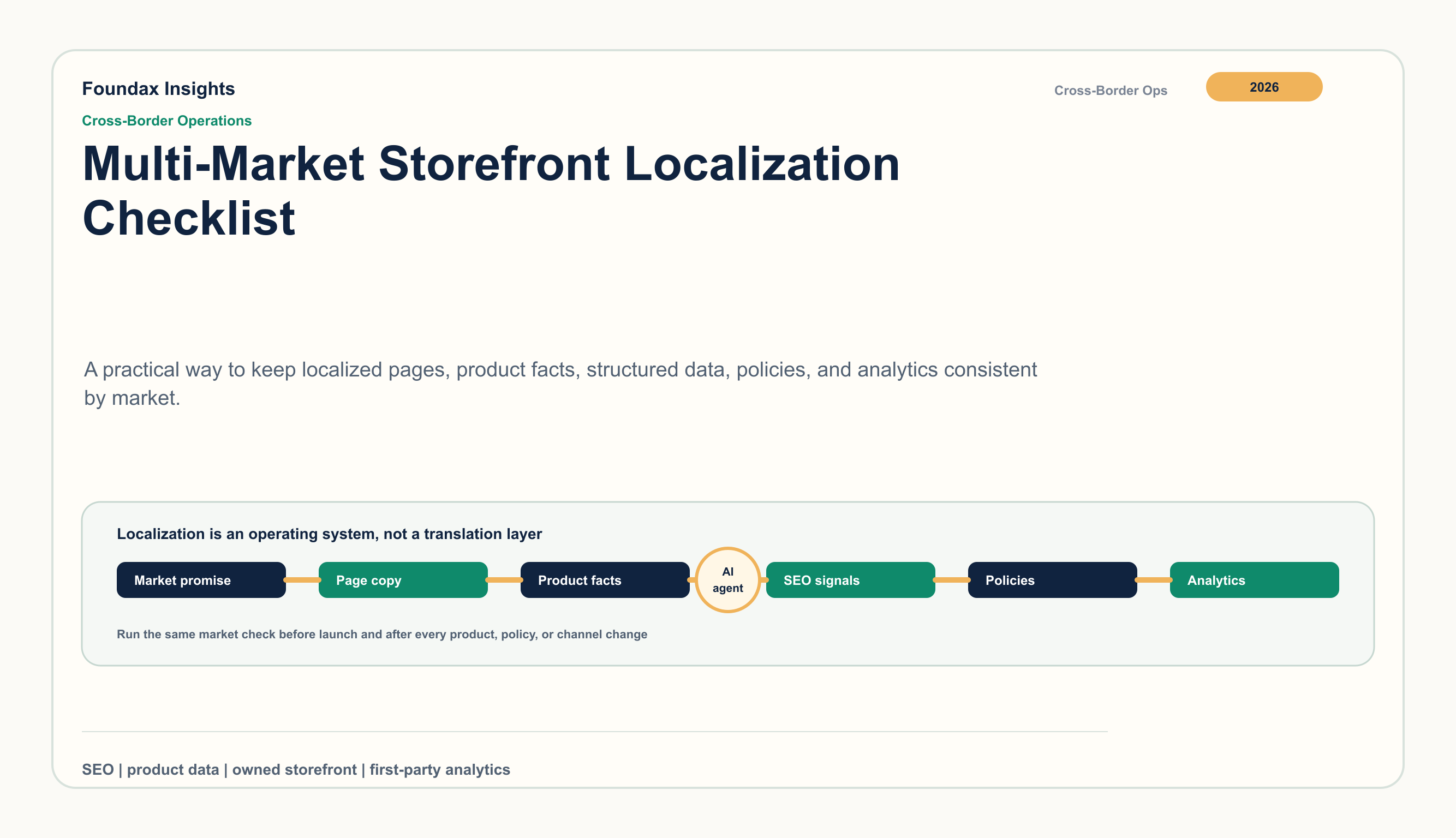
Lokalisasi tidak berhenti pada terjemahan. Tim perlu menjaga janji pasar yang sama di halaman produk, checkout, kebijakan, data terstruktur, permukaan Google, dukungan, dan analytics.
Tentukan janji pasar terlebih dahulu
Use one market promise before translating pages: product facts, final price, delivery responsibility, and discovery signals should describe the same market. Review PDP copy, checkout, policy pages, structured data, Merchant Center data, and analytics together.
Perlakukan harga dan mata uang sebagai keputusan operasi
Localized currency changes margin and trust. Stripe documents that adaptive pricing exchange rates shown to customers include a 2-4% conversion fee. Teams should model who absorbs that cost and keep PDP, cart, checkout, Product JSON-LD, and merchant data aligned.
Selaraskan fakta produk di halaman dan kanal
Google Merchant Center landing page guidance points to accurate price and availability on the page, preferably available in the initial response. Product JSON-LD and feed data should match the localized page, especially title, description, image, price, currency, availability, variants, brand, identifiers, and policy context.
Gunakan hreflang dengan halaman lokal yang nyata
Google hreflang helps connect localized URL variants, but each URL still needs real local content. Check indexability, canonical paths, localized SEO titles, same-locale internal links, and market-specific shipping, return, support, and buying details.
Bangun kepercayaan lewat kebijakan dan dukungan
Shipping, duty, returns, privacy, support hours, and post-purchase emails should repeat the same market promise. A translated policy template is weak when the actual warehouse route, refund workflow, or support channel has not been decided.
Ikuti niat pencarian lokal dalam konten
A localized content calendar should follow local search intent. Build FAQs, comparisons, units, imagery, and internal links around local buyer questions, then segment analytics by market to see discovery, checkout, return, and support friction.
Hubungkan workflow dengan Foundax
Foundax connects product records, localized pages, SEO metadata, sitemap and robots behavior, PDP Product JSON-LD, Google Merchant Center preflight and sync, Search Console workflows, Content Studio, multilingual publishing, and first-party analytics in one operating workflow.
Rencana kesiapan 30 hari
Choose priority SKUs and write the market promise.
Localize product facts, images, SEO metadata, and FAQs.
Align page price, checkout price, structured data, and merchant data.
Confirm shipping, duty, return, privacy, and support language.
Review hreflang, canonical paths, sitemap inclusion, and internal links.
Track market-level product views, add-to-cart, checkout errors, returns, and support themes.
Pertanyaan yang sering diajukan
What separates translation from storefront localization?
Translation changes words. Storefront localization aligns words with price, product facts, structured data, policy, support, channel data alignment, and analytics for a specific market.
Which checks matter before launch?
Start with price consistency, product-data consistency, shipping and return clarity, localized SEO metadata, hreflang/canonical review, and market-level analytics.
Does each market need a separate storefront?
Markets can share a storefront when language, currency, pricing, tax treatment, shipping promise, policy pages, and support workflow are the same. A more separate experience helps when those facts diverge.
How does Foundax help?
Foundax gives teams one workflow for localized pages, product records, SEO metadata, Product JSON-LD, Google workflows, content publishing, and first-party analytics.